A HIFU facelift comparison is rarely about finding one treatment that is simply “best”. It is about understanding what your skin needs now, how much change you would like to see, and whether you prefer gradual refinement or a more dramatic result. For clients who want to look fresher, firmer and beautifully rested without surgery, HIFU can be a compelling option – but it has a different role to radio frequency, microneedling and a surgical facelift.
At The Beauty Box Pangbourne, every advanced skin treatment begins with the person in front of us. Your skin quality, facial structure, lifestyle and comfort matter just as much as the technology itself.
“At The Beauty Box Pangbourne, every advanced skin treatment begins with the person in front of us.”
HIFU facelift comparison: what does HIFU actually do?
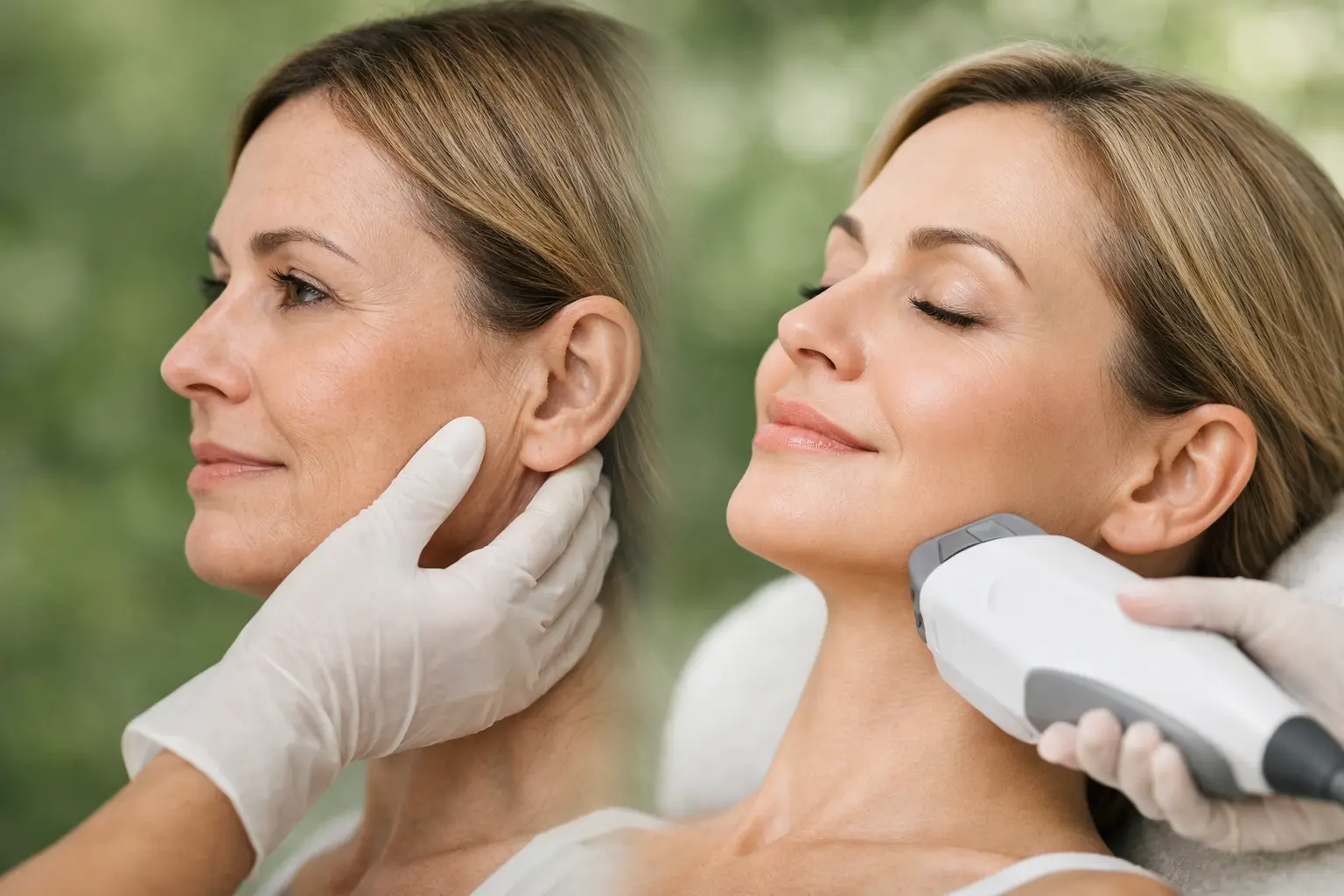
HIFU stands for high-intensity focused ultrasound. It uses carefully targeted ultrasound energy beneath the skin’s surface to create precise points of heat at selected depths. This stimulates the body’s natural wound-healing response and encourages fresh collagen production over time.
Unlike a facial that works mainly at the surface, HIFU is designed to reach deeper structural layers associated with skin support. It can be particularly effective around the jawline, cheeks, brow area, neck and décolletage, where laxity can make the face appear less defined.
The treatment does not physically remove loose skin or reposition underlying muscles. Instead, it encourages a gradual tightening and lifting effect as collagen renews. That distinction is central to any honest HIFU facelift comparison. HIFU offers non-surgical refinement, not the immediate and transformative change of surgery.
Most clients begin to notice an improvement in firmness within several weeks, with results continuing to develop over two to three months. Depending on the area treated, skin condition and treatment plan, results can last around 12 to 18 months. Some clients choose periodic maintenance to preserve their result.
HIFU versus a surgical facelift
A surgical facelift remains the most powerful option for significant skin laxity, heavier jowls and deeper folds. During surgery, excess skin may be removed and deeper facial tissues can be lifted and repositioned. Results are more pronounced and longer lasting, but the commitment is greater too: anaesthetic, incisions, swelling, bruising, recovery time and a higher financial investment all need careful consideration.
HIFU appeals to clients who are not ready for surgery, do not want downtime, or would prefer to preserve a naturally refreshed look. A HIFU appointment usually allows you to return to normal activities straight away. The skin may look slightly flushed and feel tender, tight or tingly for a short time, but visible recovery is typically minimal.
The trade-off is subtlety. If you have substantial excess skin or would like a clear repositioning of the lower face and neck, HIFU may leave you underwhelmed if your expectation is a surgical-level lift. On the other hand, if your concern is early laxity, a softened jawline or a loss of bounce in the cheeks, its gradual, collagen-led improvement can look wonderfully natural.
Age alone does not decide suitability. Some people in their forties have excellent skin elasticity and are ideal candidates for HIFU, while others may have concerns that are better addressed through a different approach. A professional consultation is the right place to discuss this openly.
HIFU versus radio frequency skin tightening
Radio frequency treatments use electromagnetic energy to warm the dermis, supporting collagen and elastin production. Like HIFU, they are non-invasive and can improve the feeling of firmness, but the two treatments deliver energy differently and are often suited to different goals.
HIFU is generally selected when the priority is a deeper lifting effect and facial contouring, especially through the lower face, jawline and neck. Radio frequency is often valued for more superficial tightening, overall skin quality and a comfortable course of regular treatments. It can be a lovely choice for skin that feels crepey, lacks resilience or would benefit from a consistent collagen-supporting programme.
Neither treatment should be judged only by the sensation during the appointment. HIFU can feel more intense in certain bony areas because it is working at focused depths. Radio frequency is usually experienced as a pleasant warmth. Comfort matters, of course, but so do treatment settings, device quality and the practitioner’s understanding of facial anatomy.
For some clients, HIFU and radio frequency are not competing choices. HIFU may provide the deeper collagen stimulation, while radio frequency can support ongoing skin firmness and radiance. The timing and suitability of combining treatments should always be personalised rather than assumed.
HIFU versus microneedling
Microneedling creates tiny, controlled channels in the skin to trigger repair and stimulate collagen closer to the surface. It is an excellent treatment for concerns such as texture, enlarged pores, fine lines, acne scarring and a lack of luminosity. It can make skin appear smoother, clearer and more refined.
Where microneedling focuses on quality, HIFU focuses more on lift. If you are concerned that your foundation sits unevenly, your pores appear prominent or your complexion has lost its glow, microneedling may deliver the more relevant improvement. If your main concern is a softer jawline, a slight drop through the cheeks or a less defined neck, HIFU is likely to be the more appropriate conversation.
There is also room for a thoughtful combination plan. A client may choose HIFU to support deeper firmness, then microneedling to enhance surface texture and radiance. Treatments should be appropriately spaced, with your skin given time to respond rather than being overloaded in pursuit of fast results.
Results, recovery and commitment at a glance
The right treatment is often clearer when you compare the practical realities. HIFU offers gradual lifting with very little social downtime and usually needs fewer sessions than radio frequency or microneedling. Radio frequency and microneedling are commonly delivered as a course, with progressive improvements in firmness or skin quality. A surgical facelift offers the most dramatic structural change and longest-lasting result, alongside the greatest recovery period and commitment.
Budget should be considered in the same balanced way. A lower price does not necessarily mean better value if the treatment is not suited to your concern. Equally, investing in a more intensive procedure before you are ready can feel unnecessary. The most satisfying plan is one that respects your goals, your diary and the way you want to feel when you look in the mirror.
Who may not be suitable for HIFU?
HIFU is not suitable for everyone, and a responsible consultation should include questions about your medical history, current skin condition and previous aesthetic treatments. It may be unsuitable during pregnancy or breastfeeding, over active skin infections or open lesions, and for certain medical conditions or implanted electronic devices. Clients with significant fillers, recent injectable treatments, severe laxity or particular skin concerns may also need a tailored approach or a different treatment altogether.
This is why an in-person assessment matters. A practitioner should examine the skin, discuss what is realistically achievable and explain any temporary effects you may experience, such as tenderness, mild swelling or sensitivity. You deserve clear guidance, not a promise that every treatment will suit every face.
Choosing the treatment that feels right for you
The most elegant results tend to come from restraint, expertise and a treatment plan that works with your features rather than trying to change them. HIFU can be a beautiful choice for preserving definition as the skin changes, especially when your aim is to look like yourself after a restful holiday rather than noticeably altered.
If you are weighing up HIFU against surgery, radio frequency or microneedling, bring your questions to a consultation and be honest about the result you hope for. With the right recommendation, your next treatment can feel less like a gamble and more like a considered moment of care for the face you see every day.