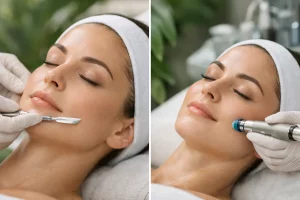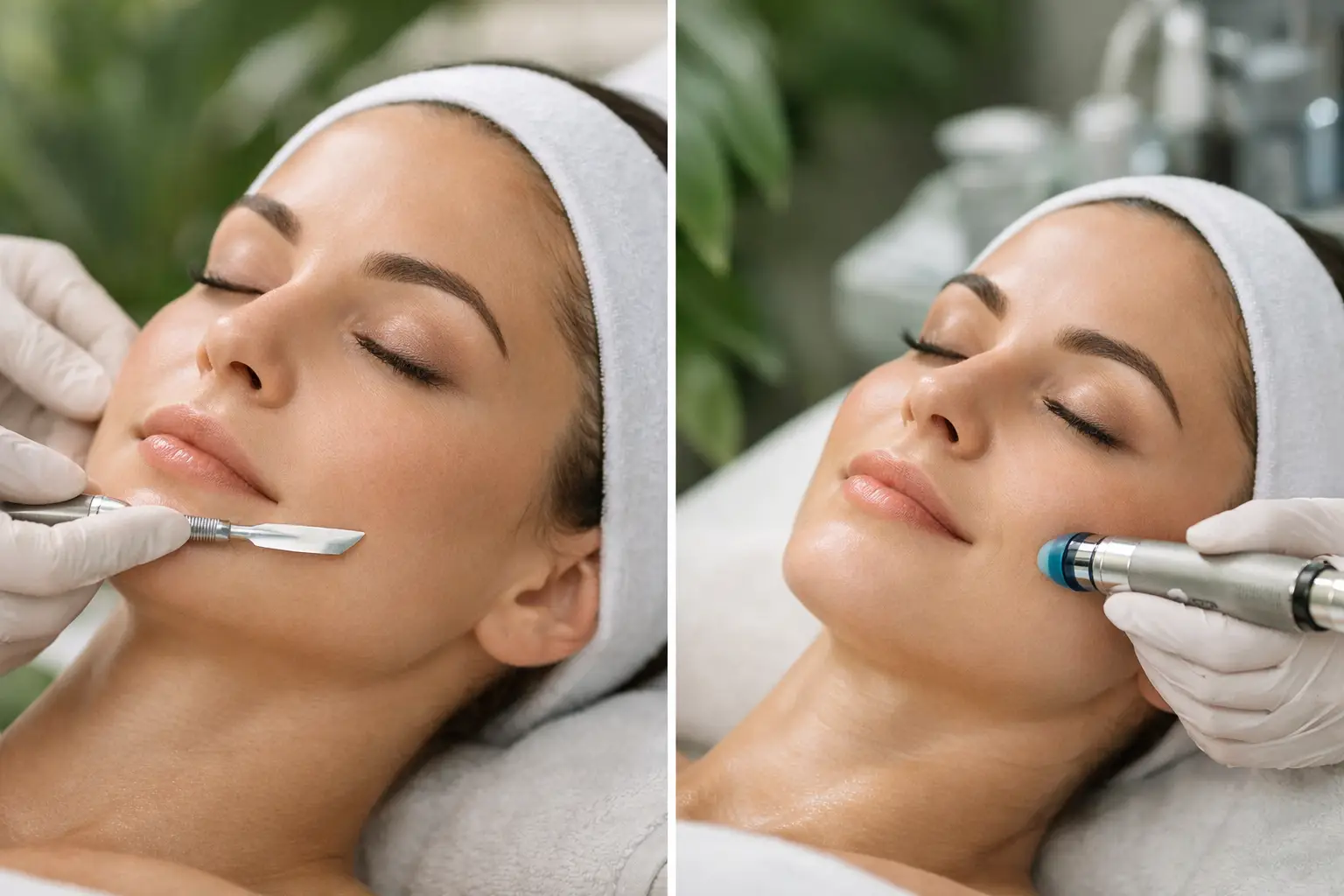
A close-up in the mirror can reveal exactly what your usual skincare routine cannot shift: a veil of peach fuzz, a slightly dull surface, make-up that no longer sits quite as smoothly, or pores that feel congested around the nose and chin. When comparing dermaplaning vs hydrafacial, both treatments can create that beautifully fresh, polished look, but they work in very different ways.
The right choice is less about which facial is ‘better’ and more about what your skin needs now. One focuses on precise physical exfoliation and hair removal; the other combines cleansing, exfoliation, extraction and hydration in one results-led facial. A thoughtful consultation matters, particularly if your skin is sensitive, breakout-prone or preparing for an important occasion.
Dermaplaning vs Hydrafacial: the key difference
Dermaplaning uses a sterile, single-use surgical blade held at a careful angle to gently remove dead skin cells and fine vellus hair from the face. It is a controlled, manual treatment performed by a trained professional. The result is skin that feels exceptionally smooth, looks brighter and provides a more even canvas for skincare and make-up.
A HydraFacial uses a specialised device and treatment tips to cleanse and exfoliate the skin, loosen and remove congestion, then replenish it with targeted hydration. Rather than simply polishing the surface, it is designed as a multi-step facial that can be tailored around concerns such as dehydration, oiliness, dullness, uneven texture and the appearance of pores.
In simple terms, dermaplaning is ideal when surface smoothness and peach-fuzz removal are the priority. HydraFacial is often the stronger choice when skin needs a more complete reset, particularly if it feels congested as well as lacklustre.
What dermaplaning can do for your complexion
Dermaplaning is a favourite before weddings, celebrations and holidays because the immediate finish is so visible. By lifting the outermost layer of dull, dead cells, it can bring a clean luminosity to the complexion. Foundation tends to glide on more evenly, and your home skincare may apply more smoothly afterwards.
It is particularly appealing for clients who notice fine facial hair catching the light or make-up clinging around dry patches. The treatment is painless for most people, though you may feel the lightest scraping sensation. There is generally little to no downtime, although a temporary flush can occur, especially in fair or reactive skin.
One common concern deserves a clear answer: dermaplaning does not make hair grow back darker, thicker or faster. Vellus hair is soft and fine. As it regrows, its blunt initial edge can feel more noticeable to some people, but the hair itself has not changed in colour, density or texture.
Dermaplaning does have limits. It does not deeply cleanse pores, treat active breakouts or replace a facial designed around hydration and targeted ingredients. It is usually avoided over active inflamed acne, open lesions, sunburn, eczema flare-ups or irritated skin, as the blade could aggravate an already compromised barrier.
How often should you have dermaplaning?
For many clients, every four to six weeks works well. This allows the skin’s natural renewal cycle to progress while maintaining that soft, refined finish. More frequent treatment is not necessarily better. Skin needs time to replenish its protective outer layer, and a therapist should always assess whether your complexion is ready.
What a HydraFacial can do for your complexion
HydraFacial is for the days when your skin feels as though it needs more than a surface polish. The treatment typically begins with cleansing and exfoliation, followed by a gentle peel solution and vacuum-assisted extraction. It is then finished with hydration and treatment serums selected to support the skin’s immediate needs.
The extraction stage is a major point of difference. It can help lift debris, oil and dead skin from congested areas without the heavy-handed feel some people associate with traditional manual extractions. Clients often leave with skin that looks clearer, fresher and intensely hydrated rather than stripped.
Its flexibility is part of its appeal. A therapist can tailor the experience for a dehydrated, city-stressed complexion, a T-zone prone to visible congestion, or skin that has lost some radiance. That does not mean every concern should be treated in the same way. Sensitive skin may require a gentler approach, while very active acne, rosacea flare-ups, dermatitis or a damaged skin barrier may mean postponing treatment or choosing an alternative.
How often should you have a HydraFacial?
A monthly HydraFacial suits many regular facial clients, especially those balancing busy schedules, make-up wear, seasonal dehydration or ongoing congestion. One treatment can give a noticeable glow, but regular appointments tend to support more consistent skin maintenance. For a special event, allow a little breathing room rather than trying a new treatment for the first time the day before.
Which treatment is best for your skin goals?
Choose dermaplaning if the main thing you want is silky-smooth skin, removal of fine facial hair and an instantly refined make-up base. It is a simple, elegant option for relatively calm skin that looks dull or textured at the surface.
Choose HydraFacial if your goals include hydration, clearer-looking pores, gentle extraction and a more comprehensive facial experience. It is often particularly satisfying when your skin is both dry and congested, or when it feels tired despite a good home routine.
If fine facial hair is your main frustration but your skin also needs hydration and pore care, you may benefit from having both treatments at different points in your skin plan. They should not automatically be combined in one appointment, however. The appropriate timing depends on your skin’s sensitivity, recent treatments and the level of exfoliation it has already had.
Results, downtime and preparation
Both treatments are often described as ‘lunch-break facials’, but that should not be mistaken for no aftercare. With dermaplaning, skin can be more vulnerable to sun exposure immediately afterwards, so daily broad-spectrum SPF is essential. Avoid harsh scrubs, strong acids, retinoids and unnecessary heat for several days, following the advice given at your appointment.
After a HydraFacial, many people can return to normal plans straight away with a healthy glow. It is still wise to keep the rest of your routine gentle for a day or two, particularly if your treatment included exfoliating acids or extractions. Skip active ingredients if your therapist recommends it, and resist the temptation to pile on products simply because your skin feels so smooth.
For either facial, arrive with an honest picture of your skin history. Mention prescription skincare, recent peels, injectables, laser treatments, allergies, pregnancy, cold sores and any changes in sensitivity. A premium facial should feel indulgent, but it should also be selected with clinical care.
Can dermaplaning and HydraFacial support longer-term skin goals?
They can, provided expectations are realistic. Dermaplaning offers an immediate improvement in surface texture and radiance, but it is not a treatment for pigmentation, scarring or deeper lines. HydraFacial supports cleaner, more hydrated-looking skin and can help maintain clarity, but it is not a substitute for a treatment plan where more significant concerns are involved.
For concerns such as persistent acne, pronounced pigmentation, fine lines or textural scarring, your therapist may recommend a considered programme that includes advanced options at the right time. The beauty of regular professional skin care is not chasing the strongest treatment. It is choosing treatments that respect your skin barrier while moving steadily towards your goals.
A tailored facial always gives the better result
At The Beauty Box Pangbourne, the most flattering treatment is never chosen from a one-size-fits-all menu. Your skin can be hydrated yet congested, calm one month and sensitive the next, or need a glow boost before an occasion without excessive stimulation.
If you are deciding between dermaplaning and HydraFacial, begin with the result you want to see in the mirror: ultra-smooth skin and a flawless make-up base, or deeply cleansed, hydrated skin with a fresher-looking glow. A professional assessment can then turn that preference into a facial plan that leaves you feeling cared for, confident and genuinely comfortable in your skin.